Consultant / Advisor Guide
I need to onboard to a new client industry and produce structured deliverables in the shortest possible time.
You onboard to new client industries regularly and need structured deliverables fast. Your clients expect SWOT, Porter's, and risk briefings — you need to produce them in hours, not days.
Working example
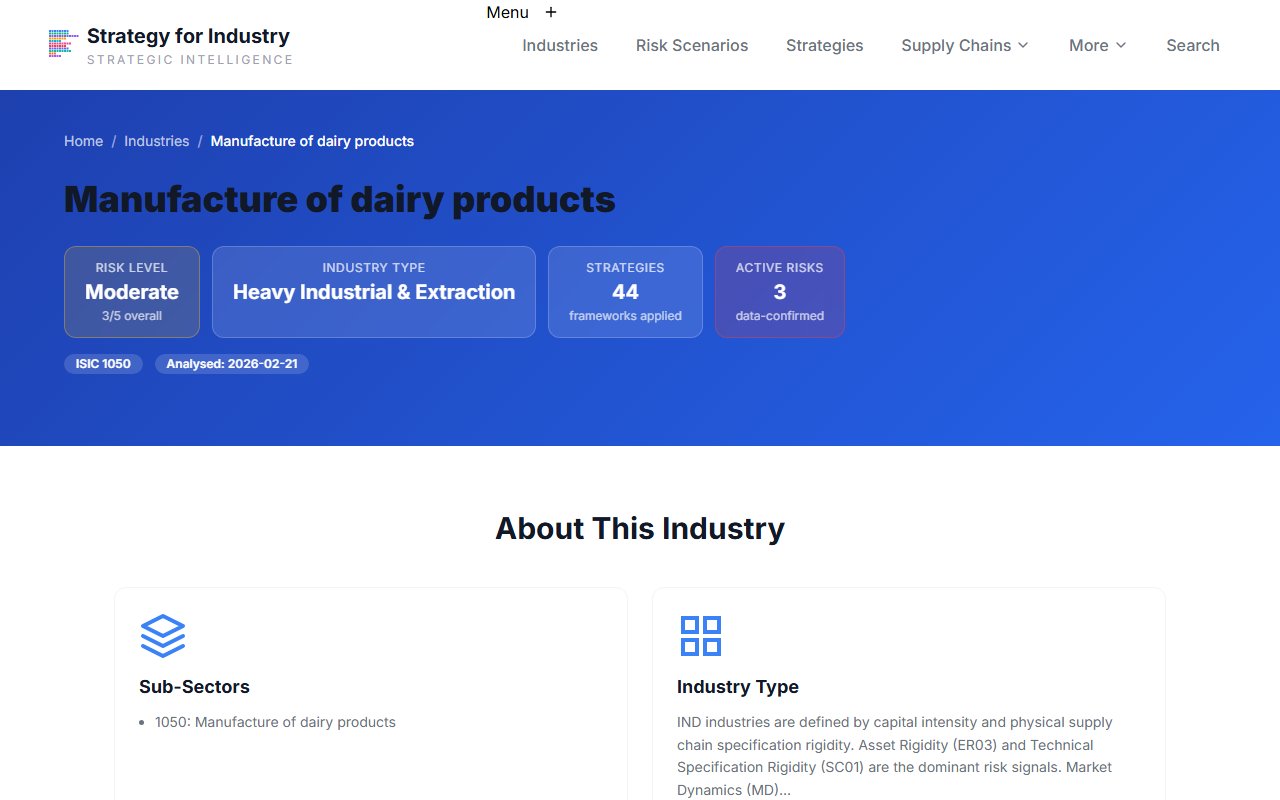
Manufacture of Dairy Products ISIC 1050
A new client in dairy processing expects a strategic briefing pack by Friday. You've never worked in food manufacturing before. You have one working day to become fluent enough to lead a credible discovery call.
Journey 1
Onboard to a new client industry in under 60 minutes
Get a complete working understanding of an unfamiliar industry — executive context, attribute scorecard, confirmed risks, and strategy framework outputs — before your first client call.
Industry Browse
Find the client's industry
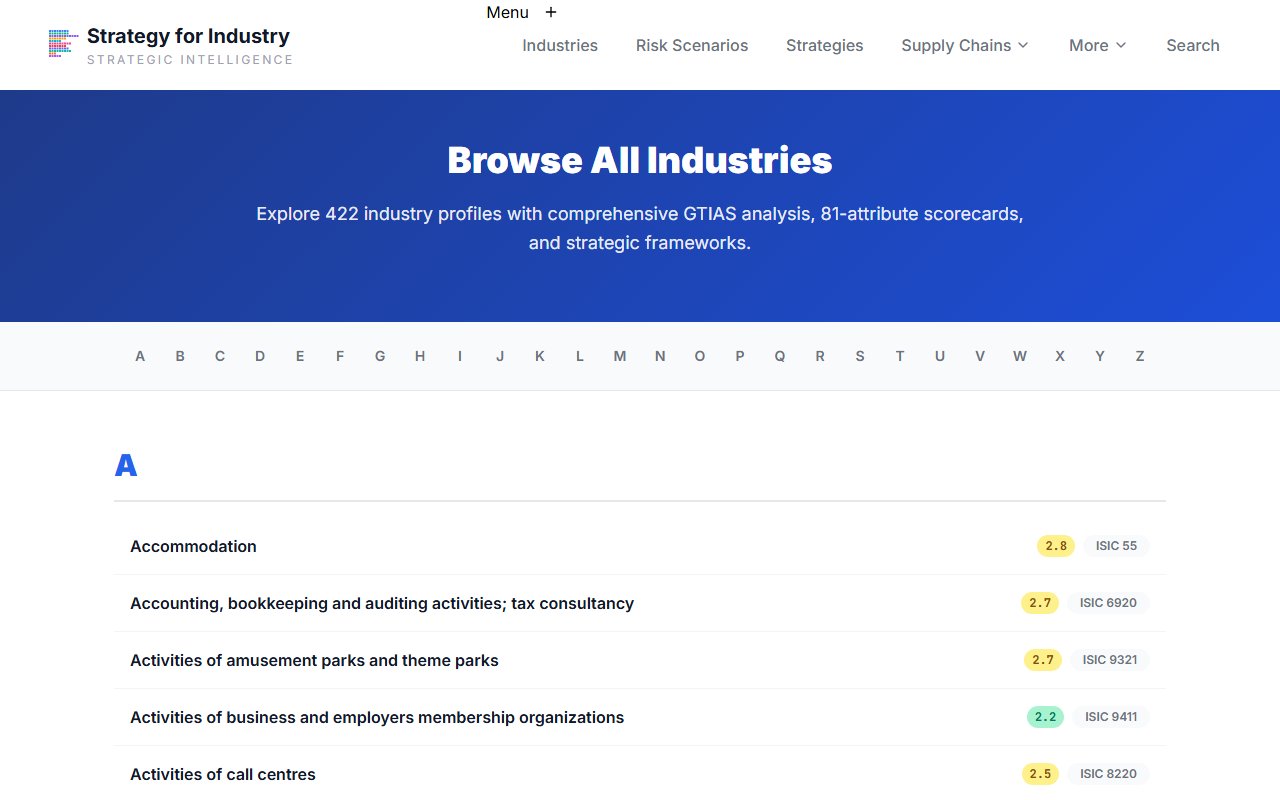
Go to Browse and search for your client's industry.
If the client gave you their SIC or NAICS code, you can often map it to ISIC via the ISIC taxonomy at /isic/. Dairy products is ISIC 1050 — search 'dairy' to find it quickly.
Industry Hub
Read the executive summary
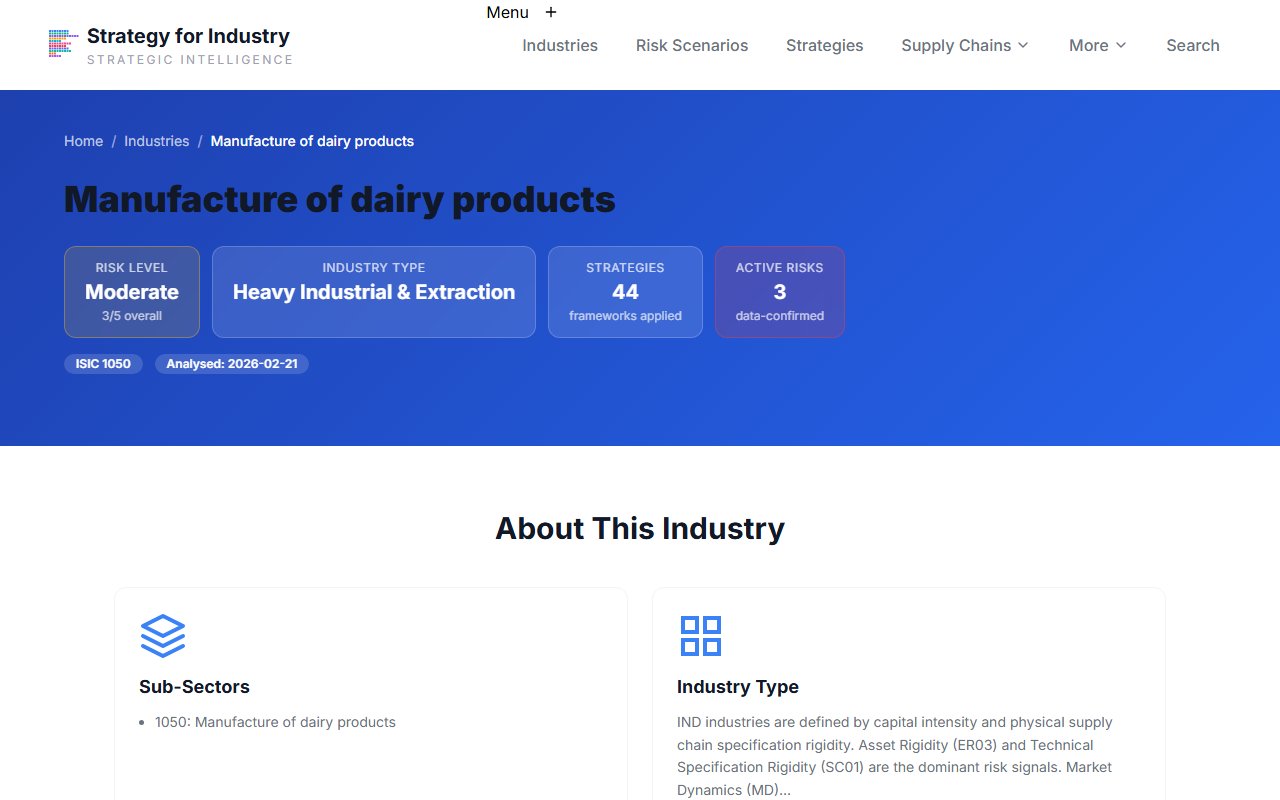
Open the industry hub page and read the full executive summary.
Read it twice — once quickly for the headline, once slowly to note what you'd ask in a discovery call. The language used here mirrors how informed practitioners in this industry talk.
Industry Scorecard
Review the scorecard for attribute diagnostics
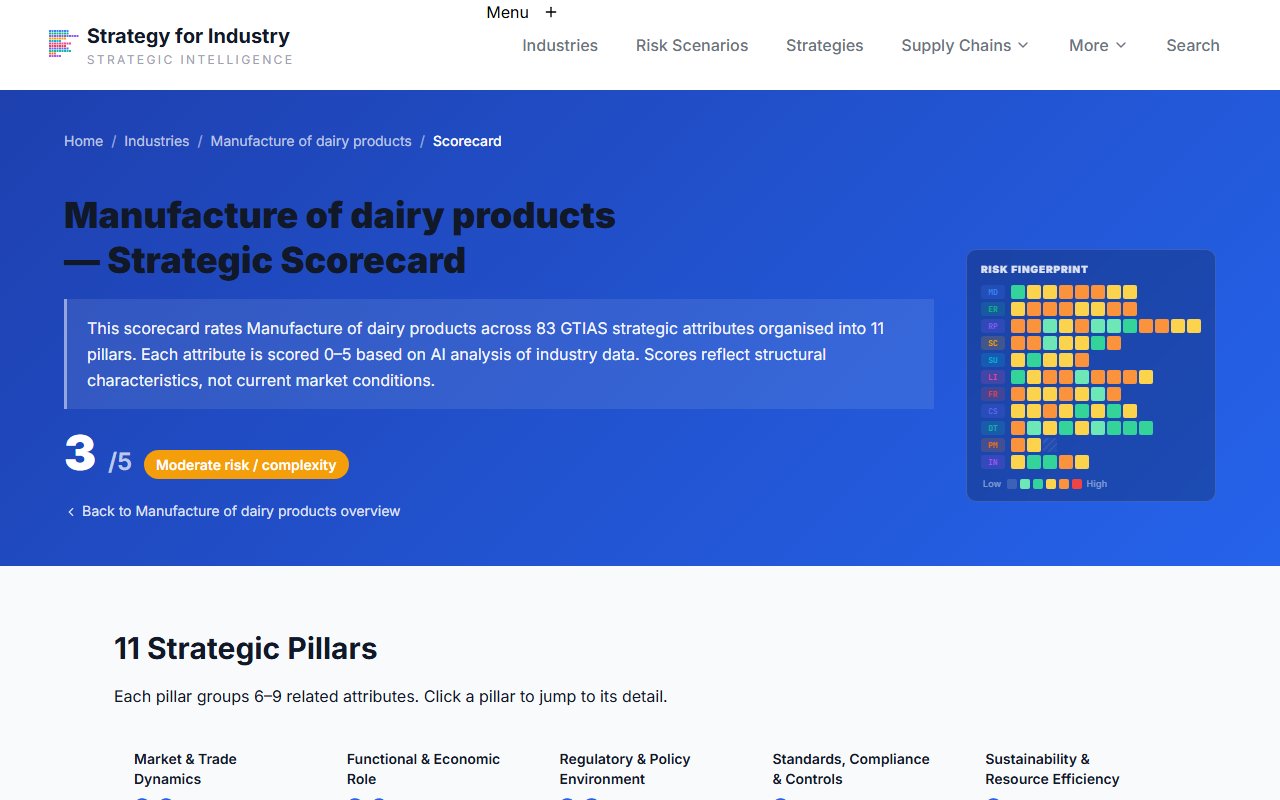
Open the Scorecard page to identify the industry's highest and lowest scoring attributes.
High-scoring attributes (4–5) are structural characteristics your client probably takes for granted. Low-scoring attributes (1–2) are often where pain exists. These become your diagnostic questions for the discovery call.
Strategies Overview
Open the strategies overview
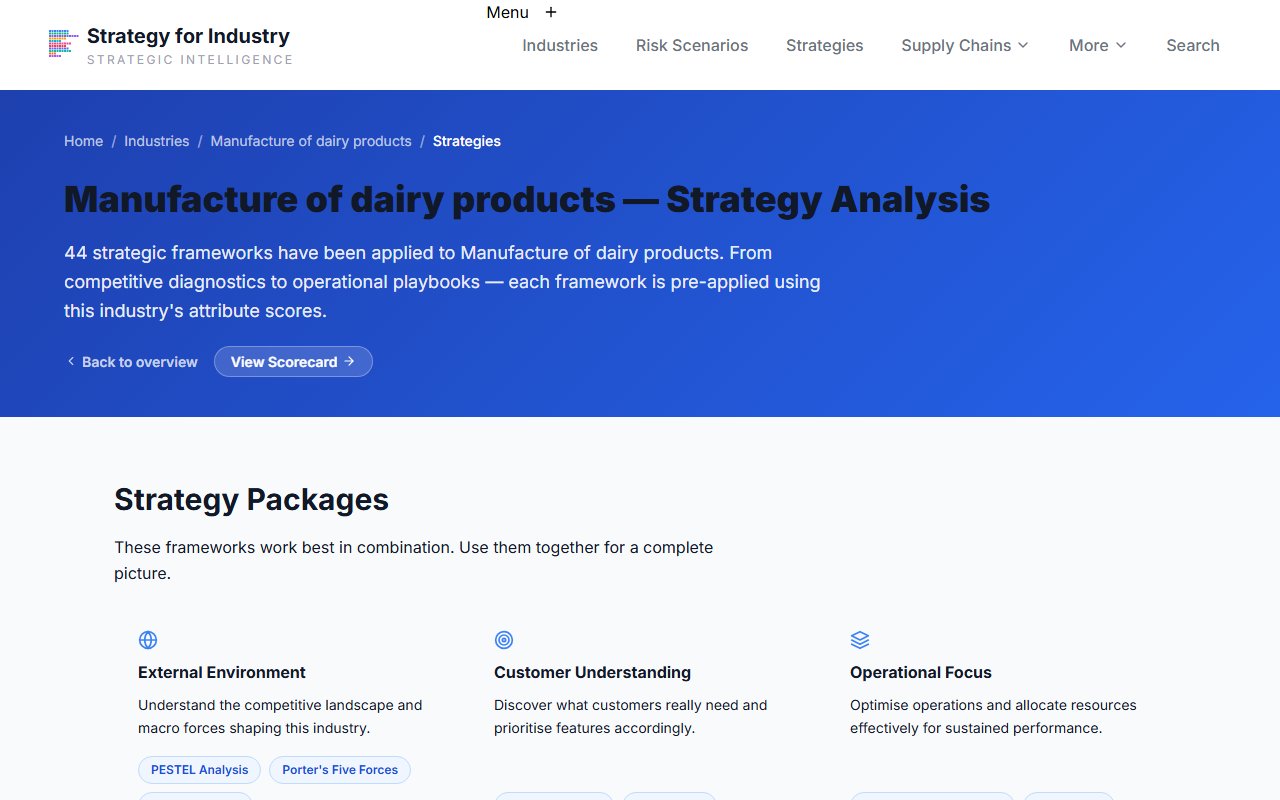
Navigate to the Strategies Overview to see all available framework analyses.
The overview shows which frameworks have structured outputs ready to use in a deck — SWOT, Porter's, PESTEL, JTBD. These are not blank templates waiting to be filled — they're pre-applied to this specific industry.
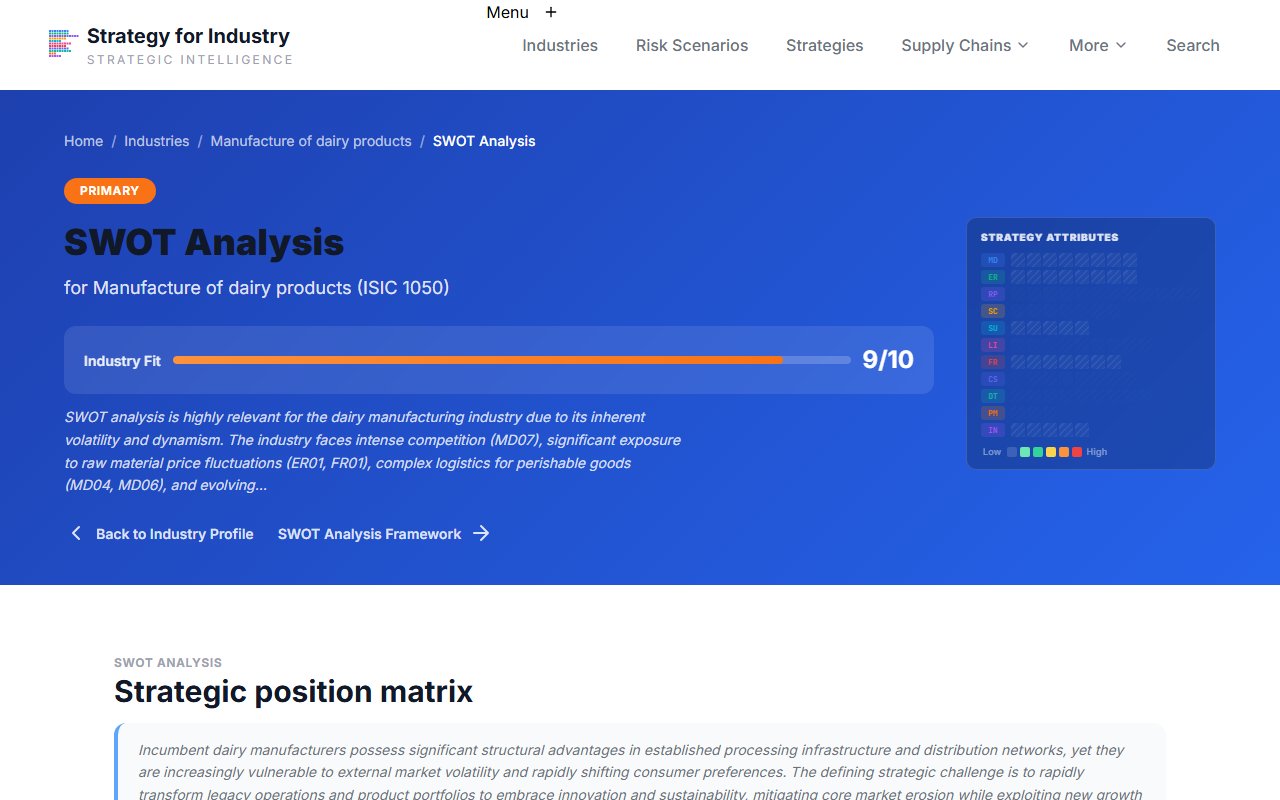
SWOT and Porter's 5 Forces
Read SWOT and Porter's 5 Forces
Open both the SWOT and Porter's 5 Forces analysis pages for this industry.
SWOT gives you the full 2×2 with attribute-linked evidence for each quadrant. Porter's gives you competitive force scores (1–5 each) with an overall attractiveness rating. Copy the key points into your deck's situation analysis slides.
After this journey
In under 60 minutes you have: an executive summary you can paraphrase confidently, a scorecard snapshot for diagnostic questions, a SWOT and Porter's 5 Forces for your opening slides, and 2–3 confirmed risk conditions ready for the risk section.
Journey 2
Build the risk section of a client briefing pack
Identify active risk conditions, access tactical playbook steps, and prepare scenario briefs that position you as an expert in the client's risk landscape from day one.
Industry Hub — Risks
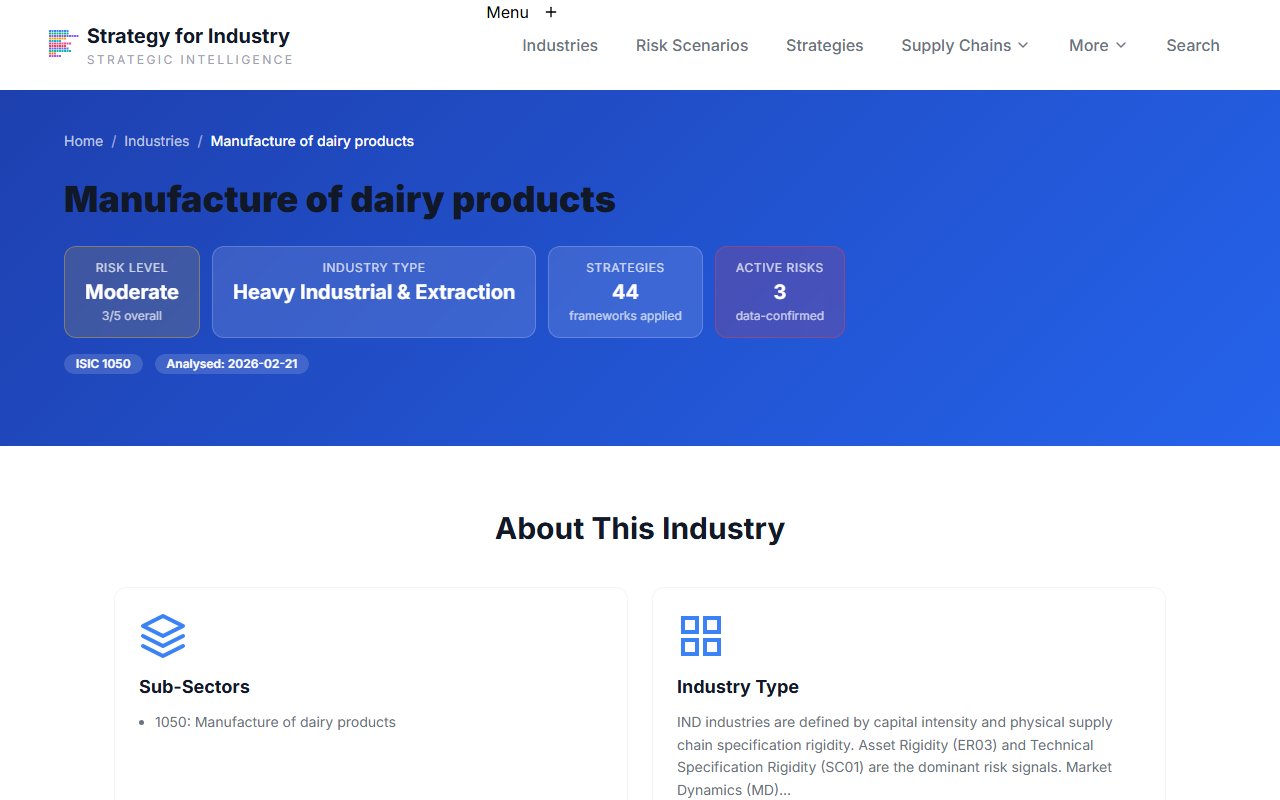
Review confirmed active risks
On the dairy industry hub, review the 'Confirmed Active Risks' section.
Present these in your briefing as 'Conditions currently active in your sector' — not 'generic risks we should watch'. The score-triggered framing is more credible than a standard risk list, and clients respond to the specificity.
Matched Scenario
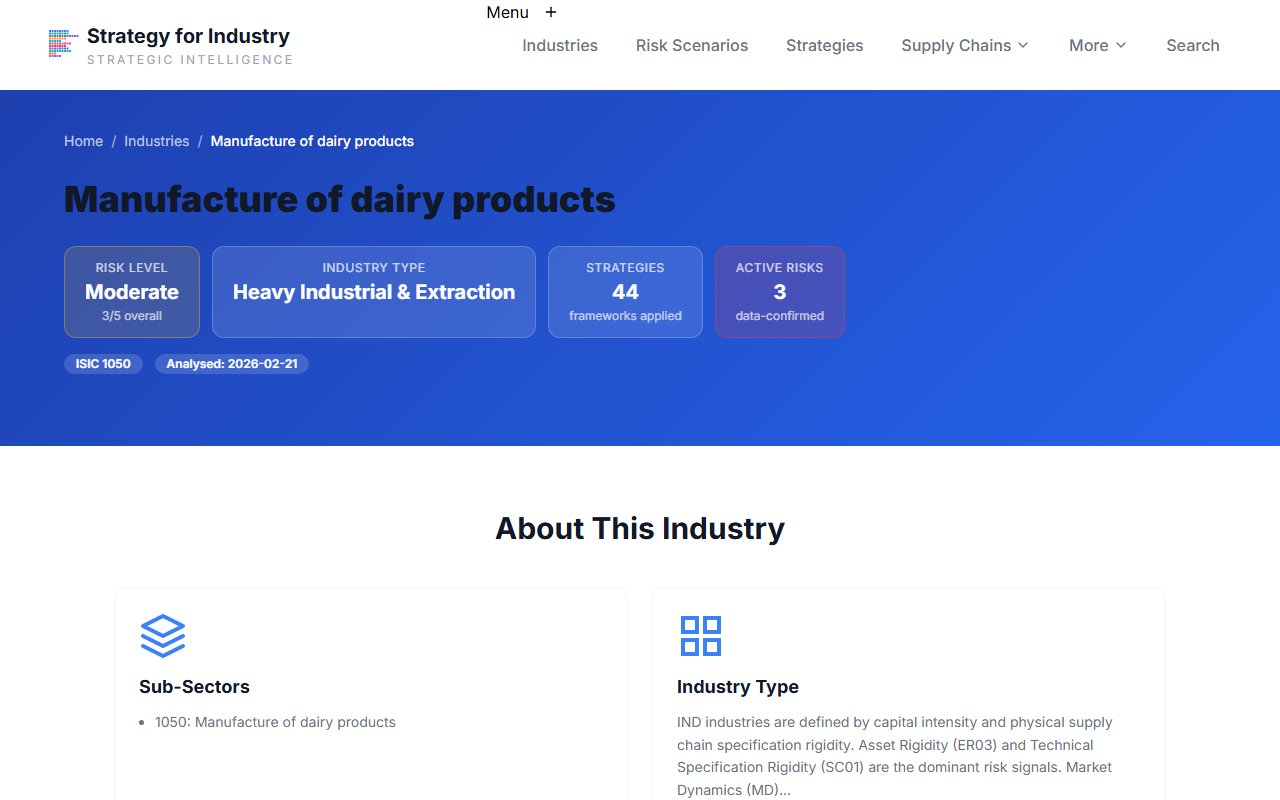
Open a matched scenario for full risk detail
Click through to the matched scenario page for the most significant confirmed risk.
The scenario page gives you: trigger conditions (the 'evidence'), business impact narrative (the 'so what'), cascade risks (the 'what happens next'), and a mitigation hint (your first recommendation). This is your risk section content, pre-structured.
Tactical Playbook
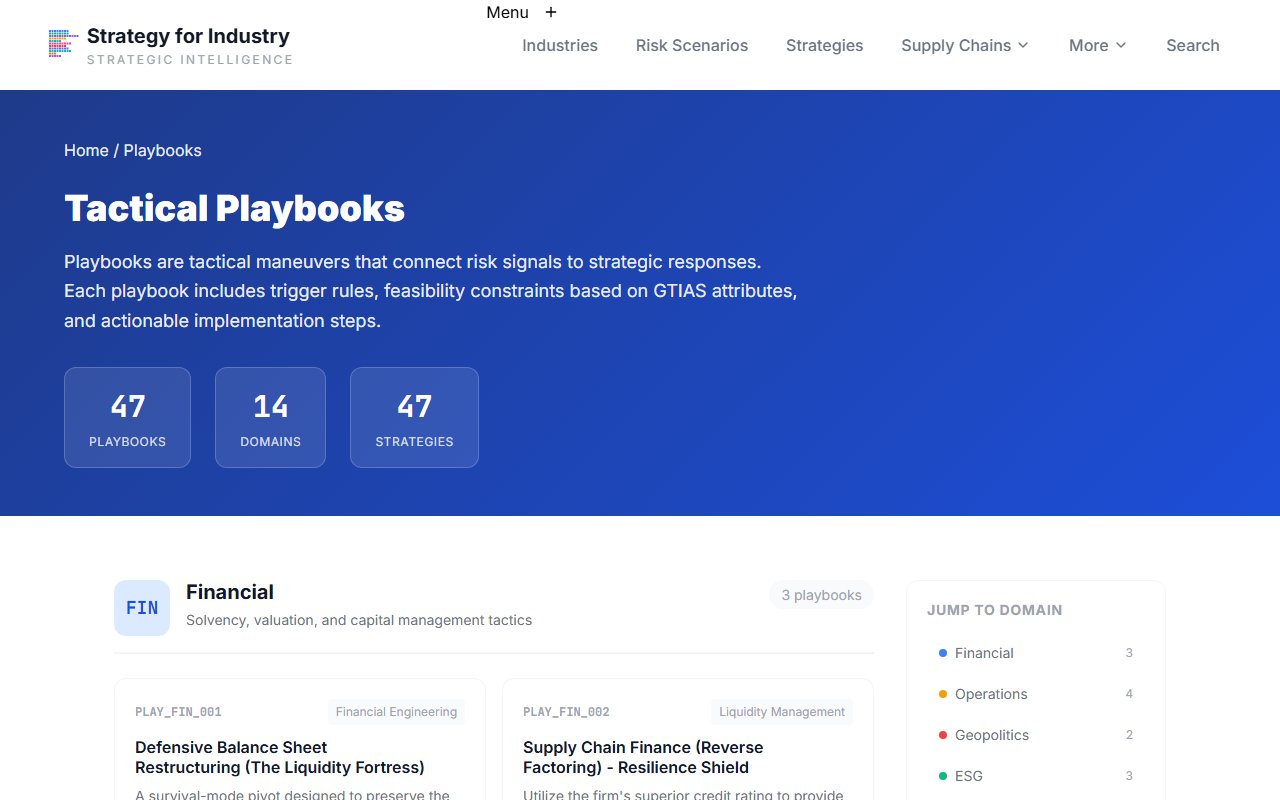
Access the tactical playbook response
Follow the playbook link from the scenario page to get specific action steps.
Frame playbook action steps as 'Recommended responses based on the conditions we've identified' — this positions your work as diagnosis-led, not framework-led. Clients respond much better to this framing.
Industry Hub — Trends
Check macro trends for forward-looking context
Scroll to the Trends section on the industry hub for amplifying macro conditions.
Macro trends add the forward-looking dimension. If a confirmed risk is being amplified by a named macro trend (e.g., 'ESG supply chain due diligence'), include it in your briefing — it shows you understand the broader context, not just the current state.
After this journey
Your risk section is complete: 2–3 confirmed conditions with trigger evidence, business impact narratives, cascade chains, playbook recommendations, and forward-looking trend context. The whole section takes 30 minutes — and reads like you've been in this industry for years.
Journey 3 — Explore next
Find strategic pivot options for a client at a crossroads
Use the Compare tool to benchmark your client's industry against an adjacent market where successful pivots have been made. Combine with the Similar Industries feature to identify industries that share the same archetype but show different growth trajectories — these are your strategic pivot analogues. Start by comparing your client's industry against the one they're considering entering.
Open the Compare toolReady to explore?
Start with the working example for this guide — or search for any industry.